Human existence is based upon risk. This text charts the adventures of a group of thinkers who embarked on a voyage of intellectual discovery, transforming primeval superstition into the powerful tools of risk control employed today.One of the foremost financial writers of his generation, Peter Bernstein has the unique ability to synthesize intellectual history and economics with the theory and practice of investment management With the stock market breaking records almost daily, leaving longtime market analysts shaking their heads and revising their forecasts, a study of the concept of risk seems quite timely. Peter Bernstein has written a comprehensive history of man's efforts to understand risk and probability, beginning with early gamblers in ancient Greece, continuing through the 17th-century French mathematicians Pascal and Fermat and up to modern chaos theory. Along the way he dem
Bagsideteksten beskriver, hvordan mennesker konstant må træffe valg og vurdere risiko. Investorer, virksomheder og andre aktører er afhængige af at kunne beregne sandsynligheder for succes og fiasko. Peter L. Bernstein fortæller i denne bog historien om de ideer og personer, der gjorde det muligt at gå fra tro på forsyn og skæbne til et fremsyn baseret på matematik og statistik. Han skildrer blandt andet tænkere som Pascal, Bernoulli, Bayes og Keynes og viser, hvordan deres teorier om sandsynlighed, risiko og usikkerhed har formet moderne finans, økonomi og beslutningsteori. Bogen forklarer også, hvorfor forståelse af risiko er central for at kunne navigere i markedsøkonomien. Type: Hardcover Dansk udgave af Peter L. Bernsteins fagbog om risikoens historie. Bogen gennemgår, hvordan mennesker gennem tiderne har forsøgt at forstå, måle og styre risiko – fra skæbnetro og krystalkugler til s
Confidence, Crashes and Self-Fulfilling Prophecies "Of all the economic bubbles that have been pricked," the editors of The Economist recently observed, "few have burst more spectacularly than the reputation of economics itself." Indeed, the financial crisis that crested in 2008 destroyed the credibility of the economic thinking that had guided policymakers for a generation. But what will take its place? In How the Economy Works, one of our leading economists provides a jargon-free exploration of the current crisis, offering a powerful argument for how economics must change to get us out of it. Roger E. A. Farmer traces the swings between classical and Keynesian economics since the early twentieth century, gracefully explaining the elements of both theories. During the Great Depression, Keynes challenged the longstanding idea that an economy was a self-correcting mechanism; but his schoo
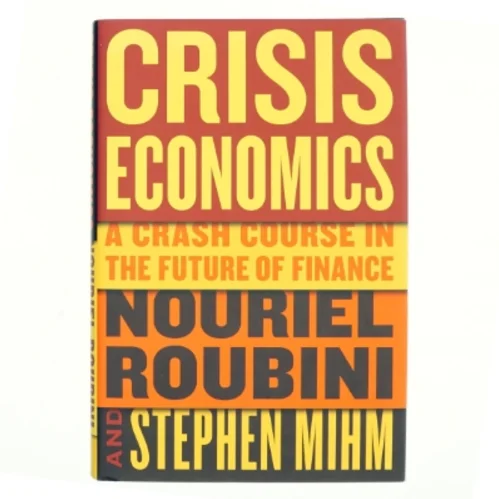
A Crash Course in the Future of Finance One man saw it coming. As far back as 2005, Professor Nouriel Roubini - aka 'Dr Doom' - warned that the US housing bubble was set to crash, and what would begin as a national disease would soon spread overseas resulting in a deep recession. Free market fundamentalism would fail and we'd be faced with the worst economic crisis in history, crippling our global economy and bringing the world's financial systems to a shuddering halt. Sound familiar? By guiding us through a crash course in 'crisis economics' - black swans and white swans, pressure points in the global economy, crises that extend beyond national borders and bubbles in the financial sector that spill over into the real economy - Roubini shows us that boom to bust economics does not have to be destiny. Roubini offers a course for the future: radical reform of the international financial or
With the immediacy of today’s NASDAQ close and the timeless power of a Greek tragedy, The Quants is at once a masterpiece of explanatory journalism, a gripping tale of ambition and hubris, and an ominous warning about Wall Street’s future. In March of 2006, four of the world’s richest men sipped champagne in an opulent New York hotel. They were preparing to compete in a poker tournament with million-dollar stakes, but those numbers meant nothing to them. They were accustomed to risking billions. On that night, these four men and their cohorts were the new kings of Wall Street. Muller, Griffin, Asness, and Weinstein were among the best and brightest of a new breed, the quants. Over the prior twenty years, this species of math whiz--technocrats who make billions not with gut calls or fundamental analysis but with formulas and high-speed computers--had usurped the testosterone-fueled, kill-
'We fed the monster until it blew up ...' While Wall Street was busy creating the biggest credit bubble of all time, a few renegade investors saw it was about to burst, bet against the banking system - and made a fortune. From the jungles of the trading floor to the casinos of Las Vegas, this is the outrageous story of the misfits, mavericks and geniuses who, against all odds, made the greatest financial killing in history. Titel: The Big Short Genre: Faglitteratur Sammendrag: Fra junglen på handelsgulvet til Las Vegas kasinoer fortæller The Big Short den opsigtsvækkende historie om misfits, renegades og visionære, der så den største kreditbobbel nogensinde nær sin sprængning – og tjente stort på det. Type: Paperback
How Human Psychology Drives the Economy, and Why It Matters for Global Capitalism From blind faith in ever-rising housing prices to plummeting confidence in capital markets, "animal spirits" are driving financial events worldwide. Forlag: Princeton University Press Udgivelsesår: 2009 Sider: 246 Sprog: Engelsk
This book brings together all the work in a new field of physics, the chaos theory, an extension of classical mechanics. The author shows how computers have been able to help researchers, by mapping the whole plane of solutions of non-linear equations. Titel: Chaos Udgave: Vintage Books udgave med forord/citater på forsiden Genre: natur_videnskab_teknologi Sammendrag: Bogen forklarer på tilgængelig vis, hvordan kaosteori opstod som et tværfagligt forskningsfelt, der forbinder fysik, matematik, biologi, meteorologi og andre naturvidenskaber. James Gleick følger udviklingen fra de første studier af deterministisk kaos og ikke-lineære differentialligninger til computerbaserede simuleringer af komplekse systemer. Gennem konkrete eksempler – blandt andet vejrsystemer, strømninger i væsker, befolkningsdynamik og mønstre i naturen – viser han, hvordan simple regler kan skabe komplekse og tilsyn